

Everything You Need to Know
About the TAP Assessment
From what the TAP measures to what your results mean, here's what athletes and parents most often ask about the assessment.
About the TAP
The TAP is an athletic mindset assessment that measures the mental intangibles important for success in sports. The TAP has a 30+ year track record of success in professional sports, contributing to dozens of championships with professional teams like the New England Patriots, San Antonio Spurs, and Kansas City Royals. It is now available for use in amateur sports to help athletes and teams reach their full potential.
The TAP consists of just under 100 questions and a single, timed exercise. It takes approximately 25 minutes to complete. Upon completion of the online TAP, a rich array of reporting results and development plans is available. This information leads to building champions.
Dr. Troutwine’s 30+ years of scientific research and data from working with elite athletes, coaches, and teams have proven that mental intangibles are tied to performance and overall success.
Coaches and athletes at all levels are waking up to this fact, and are actively looking for tools to help with the mental game to provide them a competitive advantage. In parallel, there is growing awareness and demand for services relating to athlete mental health and wellness. Recent studies have shown that today’s competitive athletes, both youth and collegiate, suffer from anxiety and other related mental health issues more than ever before. A recent NCAA survey showed more than 50% of college athletes suffer from overwhelming anxiety.
Yet, most of us have no idea on how to evaluate or approach the mental game. Today, it seems only the elite college teams or pros have access to a mental skills coach or sports psychologist.
It all starts with the TAP assessment. The TAP is like your personal mental GPS to success in athletics—it tells you where you are currently, and where you need to go to reach your full potential for success and wellbeing.
In the first study of the original version of the TAP, NFL coaches independently validated that 85% of the player’s profile statements were highly accurate.
During the early phase of the TAP, profiles were tracked in several ways. “Profile” here is defined as the interpretative report and the draft prospect’s global evaluation generated from the test results. Profiles were compared to outcomes such as a player making a team, performance, etc. One clear finding was that later round picks who had positive profiles had a greater chance of making a team and playing in the NFL (p < .025).
TAP accuracy was further demonstrated by a study of basketball coaches and players, where coaches were asked to identify their players based solely on the TAP reports (the names were redacted). This study of 3 coaches and 36 total players found the coaches were able to accurately identify 35 out of 36 (97%) of the players correctly based solely on their TAP report.
More recent studies have focused on specific sport performance statistics tied to TAP results. A combination of TAP traits was found to correlate with net yards/attempt for NFL quarterbacks. Another study showed certain TAP traits are related to batting averages of MLB players. A third showed tennis serve accuracy among tennis players is correlated to higher scores on a TAP scale.
Yes. The TAP has been scientifically validated in a multitude of manners including:
- Construct validation of the TAP was completed using existing validated instruments, such as the 16PF.
- Criterion validation was demonstrated by the above mentioned study of basketball coaches correctly identifying 35 of 36 unnamed players solely by their TAP reports.
- Predictive validation was demonstrated in a multi-year project with the US Department of Defense and the US Navy SEALs. This project demonstrated that when combining TAP results with a passing score on physical testing (swim and run times), the combined results accurately identified individuals that would pass BUD/s training and become a SEAL 92% of the time. Overall pass rates at that time hovered around 20%.
Like other proprietary instruments in the field such as the Gallup StrengthsFinder, Dr. Troutwine has chosen not to publish the TAP assessment for peer review. This does not negate the TAP’s validation. This decision instead protects the proprietary and confidential nature of the TAP and its scoring methodology. This is especially important for our clients in professional sports.
Dr. Troutwine has developed assessments like the TAP for companies like Ford and Sprint that predict job performance. None of these assessments are published for public consumption; all have remained proprietary and confidential.
The TAP has a 30+ year record of success in player personnel assessment and coaching with leading teams in the NFL, MLB, NBA, NHL, NCAA—and also the US Department of Defense. Many professional championships have been won by teams using the TAP, including the New England Patriots, Kansas City Royals and San Antonio Spurs. As you can imagine, the TAP has many success stories that helped shape the history of the NFL, MLB, and more including:
- TAP was used by NFL Hall-of-Famer Bill Polian to build the rosters for the Buffalo Bills, Carolina Panthers and Indianapolis Colts. The TAP and Dr. Troutwine famously helped the Colts choose Peyton Manning over Ryan Leaf in the 1998 NFL draft.
- TAP was used to build the New England Patriots rosters during the entire tenure of Bill Belichick – including providing insights to the Patriots as to Tom Brady’s strong mental intangibles in the 2000 NFL draft.
- TAP was systematically used over the years to build the roster of 2015 World Series champion, the Kansas City Royals, specifically targeting players that scored high in mental toughness. This provided a competitive advantage to the smaller-market team.
- TAP was used by a South African sports psychologist in 2016 with three of his client teams. Each team won professional championships in rugby, cricket, and netball in their first season of using the system.
Absolutely. Here’s why:
Dr. Troutwine has been involved in sports for five decades and has seen tremendous advancements in sports medicine, nutrition, athletic training, specialized coaching, technology, and equipment. For the most part, amateur athletes have been able to take advantage of these advancements, resulting in this generation of athletes being the most physically gifted and technically trained ever. However, Dr. Troutwine noticed that there was one area where athletes were not making similar gains—in fact, they were actually getting worse. This was in their mental game. A historical look at the TAP database shows a clear trend that the athletes coming up through the ranks are weaker mentally than previous generations. See the chart below tracking Mental Toughness scoring from our recent NFL Combine participants:
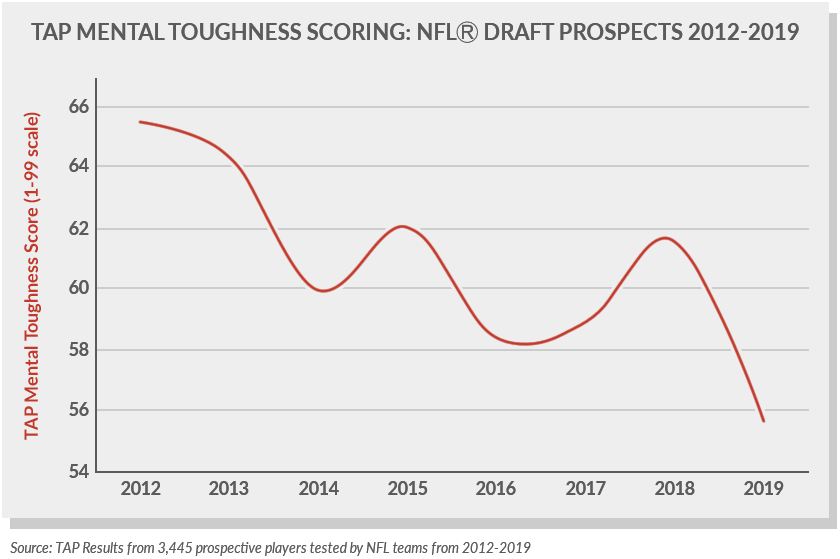
This begs the question: Why are we producing athletes with lower mental toughness? Consider the environment for teen athletes today:
Today’s Teen Athletes:
- Feel higher societal pressure to succeed in sports, school, and life
- Are overscheduled
- Often have highly-engaged parents with high expectations
- Grew up with “participation trophies” as the norm
- Communicate primarily online or on phones
- Have to deal with all the pressures of social media
Resulting In:
- Lower mental toughness
- Higher anxiety and stress
- Poor communication skills
- Relationship challenges
- Performance struggles
Although Dr. Troutwine loves working with pro teams, this realization inspired Dr. Troutwine to dedicate a large part of the remainder of his career to building tools and systems to help younger, developing athletes with their mental game.
Dr. Troutwine firmly believes that athletics are a golden opportunity to mold young people with positive characteristics and life skills that will serve them not only in athletics and academics, but for their entire life. The TAP ensures all the stakeholders in an athlete’s development—the athlete, parent, and coach—are armed with the insights, tools, and techniques to be most effective in interactions, to foster development, and to optimize performance. This information helps all the stakeholders get the most from their experience in athletics, all while guiding the athlete towards reaching full potential in sports and in life.
The TAP is highly reliable, meaning a person’s scores are very consistent and do not vary much from day to day. Reliability checks have yielded high figures, r = .92, (where a value of 1.00 would be perfect). This study was derived from 92 players that took the TAP while in college and then retook the TAP later at the NFL Combine.
Taking the TAP
You can purchase the TAP while registering for an event through Ryzer. After purchasing, you will receive an email with a link to take the TAP. The email link does not expire and can be used at any time.
Once the assessment has been completed, the results are automatically shared with the Ryzer users with access to the profile.
It takes approximately 25 minutes to complete. It is recommended that the TAP is completed in one uninterrupted session in a quiet setting with a strong Wi-Fi connection.
Athletes, their coaches, and parents can usually grasp the physical qualities of the athlete but are “blind” to mental qualities that impact athletic performance. The TAP shines a spotlight on these unknowns so that all stakeholders in an athlete’s development—the athlete, coach and parent/mentor—are armed with the insights, tools, and techniques to be most effective with interactions, to foster development, and to optimize performance.
It is also quite enjoyable to take the TAP. Most people enjoy learning more about themselves, and the TAP will provide plenty of insight about what makes one “tick”—including strengths and opportunities for improvement. Athletes, however, often report that they most enjoy learning their matched athlete type, and which prominent pro athletes share their same type.
TAP Results
The TAP provides an array of results in the form of scoring metrics, graphics, and narrative text.
TAP results provide
- A baseline of one’s athletic mindset
- Insights and guidance for the athlete, parent, and coach
- Development suggestions and path to reaching full potential
TAP results for Athletes include
- Athlete Type: Matches athlete to 1 of 8 successful athletic mindset types
- Performance Trait Scoring: An athlete’s results on each assessment
- Sports Psychologist Commentary for Athlete: Custom insights and guidance
- Sports Psychologist Commentary for Parent: Custom insights and guidance
TAP results for Coaches & Teams
- Athlete Type: Matches athlete to 1 of 8 successful athletic mindset “types”
- Performance Trait Scoring: An athlete’s results on each assessment
- Mindset Indicators: Visual shortcuts to quickly understand an athlete’s mindset for coaching
- Sports Psychologist Commentary for Coach: Custom insights and guidance
- Analytics: Broken down by team/sport/position to aid in understanding each athlete’s and the team’s mindsets in comparison to others
The matched Athlete Type is the first thing an athlete sees after completing the TAP. This important first impression is purpose-built to be a positive introduction to one’s athletic mindset. The experience goes like this: “Cool, I am an Eagle just like Cat Osterman, Mike Trout, and Peyton Manning.” The athlete can then look at the characteristics, strengths, and struggles of their matched type. They instantly have a positive kinship with multiple prominent athletes. Knowing certain pros have similar mental strengths and struggles goes a long way to help younger athletes buy in and feel not only comfortable, but pumped, about using our system.
The Athlete Type provides a high level overview of an individual’s mental make-up.
Introduces a common framework for coaches and athletes to better understand and interact with one another.
Athlete Types provide a positive self-identifying image for athletes.
Most find it interesting and fun to learn their Athlete Type and share it with others.
Yes, we see it in two common scenarios. First, when the athlete is immature and still developing their personality, they may evolve later into their true type. Second, many athletes are “hybrids” of multiple athlete types (their proximate match is a similar distance from two or sometimes three types) and they may see a new top-matched type from TAP to TAP.
This is the section where an athlete receives a personal evaluation and guidance directly from Dr. Troutwine. His 30+ years of research and analysis are leveraged to provide this custom analysis.
The athlete’s results on TAP traits are used to produce text describing the athlete’s makeup in 6 important areas:
- Competitive Nature
- Coping Style
- Work Style
- Mental Characteristics
- Social Style
- Problem Solving Approach
The first three sections also include a list of 7 or more suggested activities for the athlete to work on to improve. Additional suggestions are often offered in the text of each section.
A statistical analysis was conducted on the TAP results of over 30,000 special forces soldiers & elite athletes, both male and female, in nearly all sports. At a broad level, the data revealed a constellation of mental characteristics that clustered into 8 types that share common athletic mindsets, traits, strengths, struggles, inspirations and most-effective interaction styles. We gave them catchy names so they are easily remembered.








When the TAP assessment is completed, we measure the scoring distance between each of the individual’s TAP scale scores and the scores of the same TAP scales for each of the 8 athlete types. The athlete type with the smallest overall scoring distance from the individual is the individual’s closest matched athlete type. We represent the proximate match with a number between 1-99. The higher the number, the closer the match and the more characteristics of the type would be expected to ring true for the individual.

Very Close Match
92 and above
Exhibits most of the type’s characteristics

Close Match
86 to 91
Exhibits many of the type’s characteristics

Match
80 to 85
Exhibits some of the type’s characteristics

Loose Match
79 and below
Exhibits a few of the type’s characteristics and is more of a unique individual than a common type
Traditionally, one of the biggest challenges with evaluating athletes on their mental game is the lack of objective standards. When you are dealing with something most coaches consider as “intangibles,” by definition, there is no way to objectively measure them. The TAP changes that thinking. With more than 30 years of research analyzing the TAP results of elite athletes, the TAP has been fine-tuned to accurately measure the mental intangibles important to success in athletics. This process involved Dr. Troutwine leveraging the evaluation protocols used by one of the most notable athletic events in the world, the NFL Combine and those used by one of the most elite special forces military units in the world, the US Navy SEALs. The result of this research and analysis allowed Dr. Troutwine to turn traditional mental intangibles into tangible, objective metrics that can be used for assessment, coaching, development, and comparison of athletes across all sports and levels of competition.
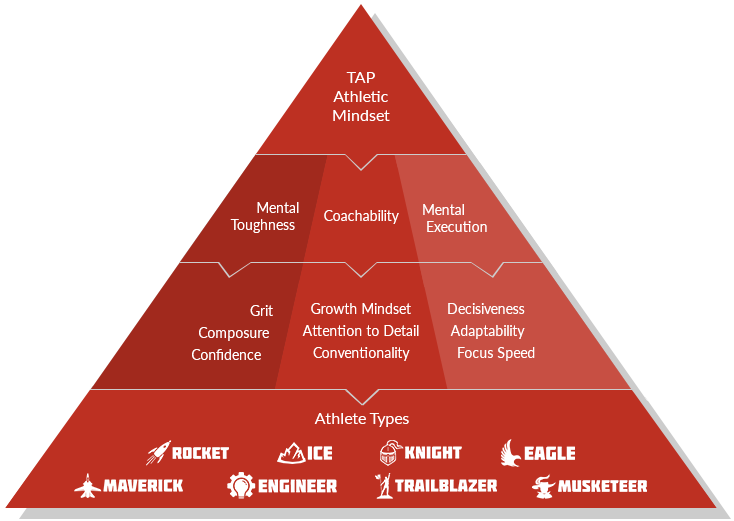
The mental intangibles in the two middle layers of the TAP Mental Intangibles pyramid above are those published in our athlete reporting upon completing a TAP. These 12 “Performance Traits” are singled out from other TAP measurements because they are highly correlated to athletic success and are thus targeted for training and development.
This is the section for the athlete’s parent or mentor based upon the athlete’s TAP results. Here, Dr. Troutwine provides custom narrative analysis, so the parent has a new-found understanding of their athlete. This information arms the parent with the insights needed to best help their athlete through the ups and downs of athletics.
Topics covered include:
- Personal Nature
- Relationships
- Motivation & Interests
- Mental Characteristics
- Practice Habits
- Performance
For each topic, Dr. Troutwine also lists personalized suggested activities for the parent who wants to support their athlete the best way possible.